
August 25, 2026
Case Study: How Levamour Scales Its Own Online Shop with Idealo Repricing
From TikTok Shop to their own online store with Idealo traffic: how perfume retailer Levamour doubled its conversion rate with automated repricing.
Paying for Idealo clicks that don't convert? How price position, price parity, your product page, and checkout decide whether German shoppers buy – with benchmarks vs. Google Shopping.
Published on by Sergei Gaponik in Idealo Conversion
On Idealo you pay for every click – but you only earn on the purchase. The metric in between is your conversion rate: the share of paid clicks that actually become orders. For international sellers entering the German market, it decides whether Idealo is a profitable sales channel or an expensive shop window.
The good news: conversion rate is not fate. It is decided at five stations – price position, total price, price parity, product page, and checkout – and every one of them can be tuned. This article walks the chain from click to purchase, with benchmarks from our own data and a direct comparison to the channel most international sellers already know: Google Shopping.
Idealo bills the classic listing per click – the standard CPC has been €0.51 for idealo.de since April 2025 (varying by category and contract). That makes conversion rate the direct driver of your acquisition costs:
Doubling your conversion rate halves your acquisition costs; halving it doubles them. No other lever acts this directly on the channel’s profitability – and for cross-border sellers, whose cost base is often higher than local competitors’, the math is even less forgiving.
If you already run Google Shopping campaigns elsewhere in Europe, here is how the two channels map:
| Channel | Typical conversion rate | Source |
|---|---|---|
| Ecommerce overall (global) | avg. 2.66% | Dynamic Yield, 12-month average |
| Google Shopping (Europe, retail) | ~3% | smec Market Observer, as of June 2026 |
| Performance Max (Europe, retail) | ~3.5% | smec Market Observer, as of June 2026 |
| Idealo, competitive price position | 3–6% | our own data from connected shops |
| Idealo, best-price position | 6–12% | our own data from connected shops |
The difference comes down to funnel stage: a Google Shopping click often arrives from a broad search – many users are still comparing or clicking exploratively. An Idealo user is already inside the price comparison: product chosen, purchase decision made, all that’s left is picking the best offer. Idealo itself markets exactly this: most of its users have already decided to buy, which it says produces a better cost-revenue ratio than other performance marketing channels.
How the two channels differ beyond conversion – cost models, ranking logic, decision matrix – is covered in our comparison of Idealo vs. Google Shopping.
The honest flip side: Idealo traffic is higher intent, but more price-sensitive. Precisely because the user is only looking for the best offer, conversion reacts brutally to your price position. Sellers priced well above the competition drop to 0.5–2.5% in our data – paying full click prices for users who primarily notice the price gap.
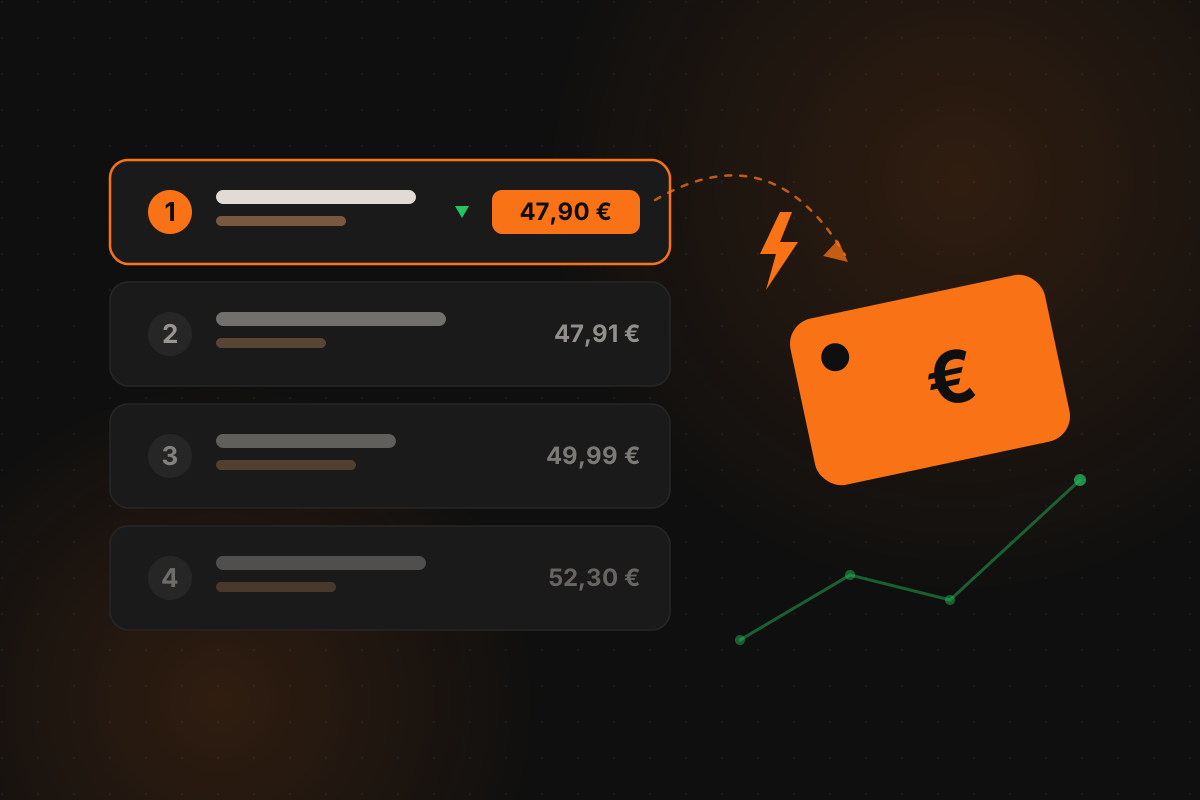
Idealo sorts the offer list by item price, and clicks concentrate radically at the top: in a partner presentation, Idealo put the distribution at over 50% of clicks for position 1, 18% for position 2, and 10% for position 3. Our own data shows the same cliff – closer to 60% on position 1, and almost nothing below position 3.
The lesser-known second effect: conversion rate is also highest on position 1.
| Idealo placement | Conversion rate (our own data) |
|---|---|
| Best price / top offer visible | 6–12% |
| Top 3 offers | 4–8% |
| Midfield, close to the best price | 2.5–5% |
| Clearly more expensive than competitors | 0.5–2.5% |
The mechanism: many shoppers click through to several shops, compare one last time – and still buy where the price is lowest. Clicks on position 2 or 3 are therefore not just “fewer clicks” but clicks with systematically worse conversion: you are paying for the final double-check of customers who order from the cheaper shop. Sitting permanently just above the best price is the most expensive position of all – full click costs, few sales.
If you want to reach a top position without lowering the price across your entire shop, dynamic discounts help: PricePirate lowers the price only through the Idealo offer link, while your regular shop price stays unchanged – more conversion on the marketplace without giving away margin in your own store. Here is how dynamic discounts work.
How to reach and hold the price position automatically without sacrificing your margin is its own topic – covered in Idealo Repricing: How Automated Pricing Works on Germany’s Largest Price Comparison Site.
Shipping costs are not part of Idealo’s sorting – but the total price is highlighted right next to each offer. Winning position 1 with a low item price and inflated cross-border shipping is the classic trap for international sellers: you win the placement and lose the buyer, at the latest on the product page when the total stands in black and white.
The conversion-optimized logic is the reverse: honest, competitive shipping costs to Germany that match exactly across Idealo, your product page, and your checkout. Unexpected extra costs are the most-cited reason for checkout abandonment according to the Baymard Institute – and an Idealo shopper who has already compared total prices reacts to deviations with particular sensitivity.
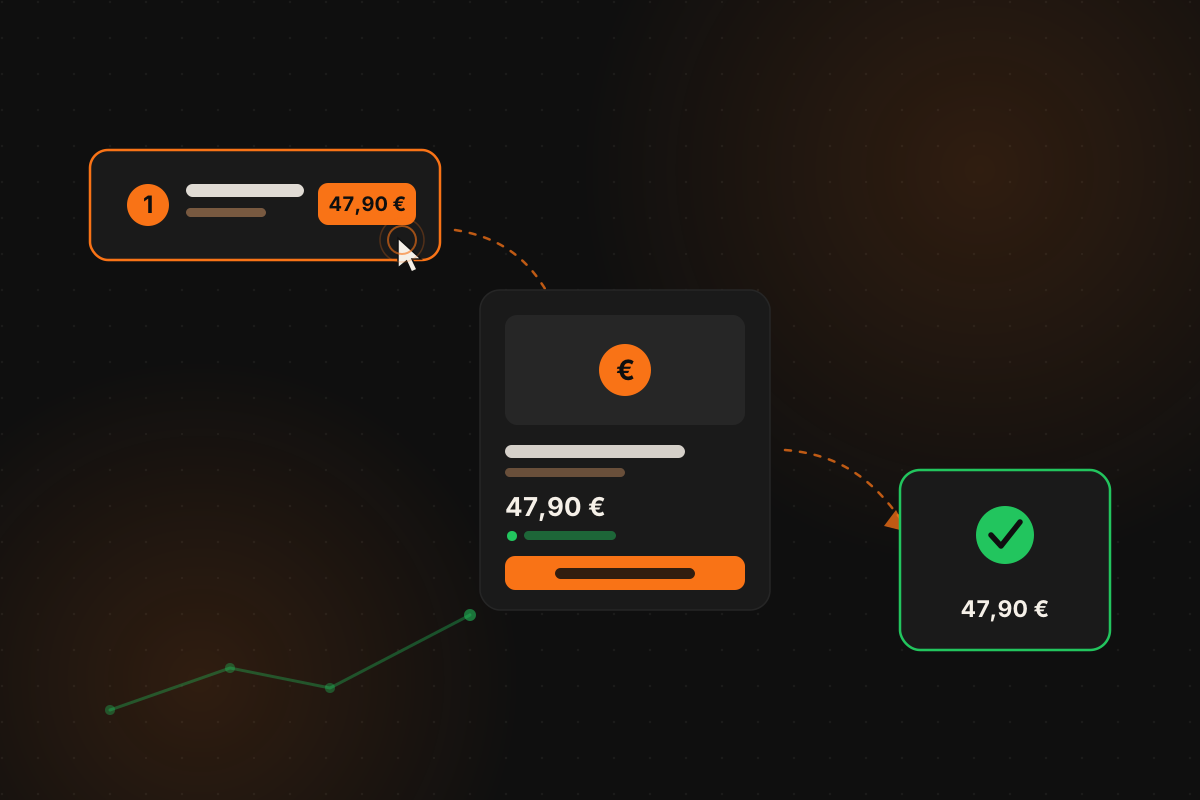
Nothing kills an almost-certain sale faster than this moment: Idealo said €47.90, the product page shows €49.90. The shopper feels misled, the back button is a thumb away – and the click is paid for regardless.
Price mismatches rarely come from intent; they come from delay. Idealo typically reads the classic CSV feed only every 30 minutes, and many connector solutions add their own lag – a price change can take up to an hour to arrive. In exactly that window, Idealo shows the old price and your shop the new one. The more often you reprice, the more often the window opens.
Two measures close it: first, your shop should be the single source of truth – shop-based repricing changes the price at the source, and the feed carries it from there. Second, fast integration pays off: via Idealo’s PWS API, price updates appear almost instantly. Our Shopify app idealo EasyConnect provides that PWS integration – combined with PricePirate, price changes reach Idealo in under 5 minutes, shrinking the parity window to a minimum.
One parity rule specific to entering Germany: consumer prices must be displayed including VAT. A landing page that surprises German shoppers with net prices or currency conversion doesn’t just hurt conversion – it breaks the price comparison they came from.
The Idealo click does not land on your homepage; it deep-links straight to your product page. For a foreign shop, that page carries double duty: it must close the sale and establish that you are a trustworthy place for a German customer to buy. What matters:
Around 70% of all carts are abandoned on average, per the Baymard Institute’s long-running numbers. The most common reasons have been the same for years – and all are avoidable:
A shop-wide average conversion rate hides more than it shows. The metric becomes meaningful per product – and diagnostic only in combination with price position:
Idealo provides the click numbers, your shop system the orders – even a simple per-product comparison shows where paid clicks leak away. A price monitoring tool like PricePirate adds the position history per product, so you can lay conversion and placement side by side.
From our data: 3–6% with a competitive price position, 6–12% on the best-price position – clearly above the global ecommerce average of 2.66%. More important than any benchmark is your own trend: same products, same channel, observed over time.
Yes – the Idealo offer list is a level playing field, and a foreign shop with the best total price ranks above established German retailers. What German buyers won’t forgive: missing German product data, surprise shipping costs, net prices, or a checkout without PayPal and invoice options. Fix those, and the price comparison works in your favor.
Check in this order: first, price position – more than a few cents above the best price, and comparers buy elsewhere. Second, total price and parity – do shipping costs and shop price match Idealo exactly? Third, product page and checkout – load time, availability, trust signals, payment methods.
Yes, twice over: it secures the price position where conversion is highest, and it keeps your shop and Idealo prices automatically consistent, because the price is changed at the source. How that works in detail: Idealo Repricing explained.
Price position and parity on autopilot? PricePirate monitors your Idealo positions, reprices by your rules directly in Shopify, and pushes updates to Idealo in under 5 minutes via the PWS connector. Start your free trial and meet PricePirate in a personal demo.
PricePirate is an independent product of UCX Media and has no business, partnership, or other affiliation with idealo internet GmbH.
Published on by Sergei Gaponik in Idealo Conversion
August 25, 2026
From TikTok Shop to their own online store with Idealo traffic: how perfume retailer Levamour doubled its conversion rate with automated repricing.
May 29, 2026
Selling into Germany? How repricing works on Idealo: the price-only ranking, proven strategies, minimum prices – and the tooling international sellers need.
July 04, 2026
Idealo and Google Shopping work fundamentally differently – in costs, traffic, and price logic. This guide shows merchants which channel pays off, and when.