For a long time, anyone who wanted to fetch Amazon prices automatically ended up at the Product Advertising API 5.0 (PA-API 5). That route is gone: Amazon has deprecated PA-API 5 and replaced it with the Creators API. Applications that still call the old endpoint only get a 403 Forbidden back, according to Amazon’s deprecation notice.
For affiliate sites, this is a migration. For everyone else, meaning retailers, pricing teams and data analysts, it is a good moment to check whether Amazon’s interface was the right tool in the first place. This article sorts through the options: the Creators API, the Selling Partner API, Keepa, your own scraper, and a price API for Amazon and other marketplaces.
What happened to PA-API 5?
PA-API was Amazon’s interface for members of its affiliate program, Amazon Associates. It delivered product data, images and offer prices so that associates could promote Amazon products on their sites. Its successor is the Creators API. The idea stays the same; credentials, authentication and registration change.
What matters are the access requirements. According to Amazon, you need:
- an associate account in the Amazon Associates program of the target marketplace that has been fully reviewed and approved,
- at least 10 qualifying sales in the last 30 days to access product data through the Creators API,
- registration by the primary owner of the associate account.
Without ongoing affiliate revenue, you don’t get to the data at all.
What the Creators API is for, and what it isn’t
Even with access, the Creators API is the wrong interface for most price data use cases. Its use is tied to the license terms of the Associates program, and those are clear. The Associates Program IP License states, among other things:
- Program content may only be used to send users and sales to an Amazon site.
- The API may not be used with sites or applications whose primary purpose is not promoting Amazon.
- Content may be cached for 24 hours at most; if you refresh prices less often than hourly, you have to show a timestamp next to them.
- Aggregating, analyzing or repurposing the content requires Amazon’s prior written consent.
A repricing tool, a BI dashboard with competitor prices, or a pricing model that compares Amazon prices with Idealo clearly falls outside these terms. The Creators API is a tool for affiliate marketing, not a market data interface.
The alternatives at a glance
| Option | What you get | What it takes | Limits |
|---|
| Creators API | Amazon catalog data for affiliate sites | Associate account, 10 qualifying sales in 30 days | Only for promoting Amazon |
| Selling Partner API | Data on your own seller or vendor account | A seller or vendor account with Amazon | Built for your own business, Amazon only |
| Keepa | Amazon price history | A paid Keepa subscription | Amazon only, focused on history |
| Your own scraper | Whatever you extract yourself | Proxies, bot defenses, maintenance | Breaks with every page change |
| PricePirate Price API | Live offers by EAN or ASIN | An API key | Coverage depends on marketplace and country |
Selling Partner API (SP-API)
The Selling Partner API is the interface for retailers and vendors who sell on Amazon themselves. It manages listings, orders, inventory and reports for your own account. If you are already a seller, you will also find price information for your own products there. It is not built for products you don’t offer, or for looking beyond Amazon.
Keepa
Keepa is the classic for Amazon price history; its API is billed through a paid subscription. If you want to know how a product’s price has moved over months, Keepa is strong. If you need the current Amazon price next to the one on Idealo and Google Shopping, the other marketplaces are missing.
Your own scraper
A scraper for Amazon product pages is quick to write and expensive to run. Amazon blocks automated requests consistently, the page structure keeps changing, and prices depend on the delivery location. What that means in practice (residential proxies, bandwidth costs, bot detection) is described in Price Scraping: Build Your Own Scraper or Use an API?. The same applies to Amazon.
Amazon prices by EAN with the PricePirate Price API
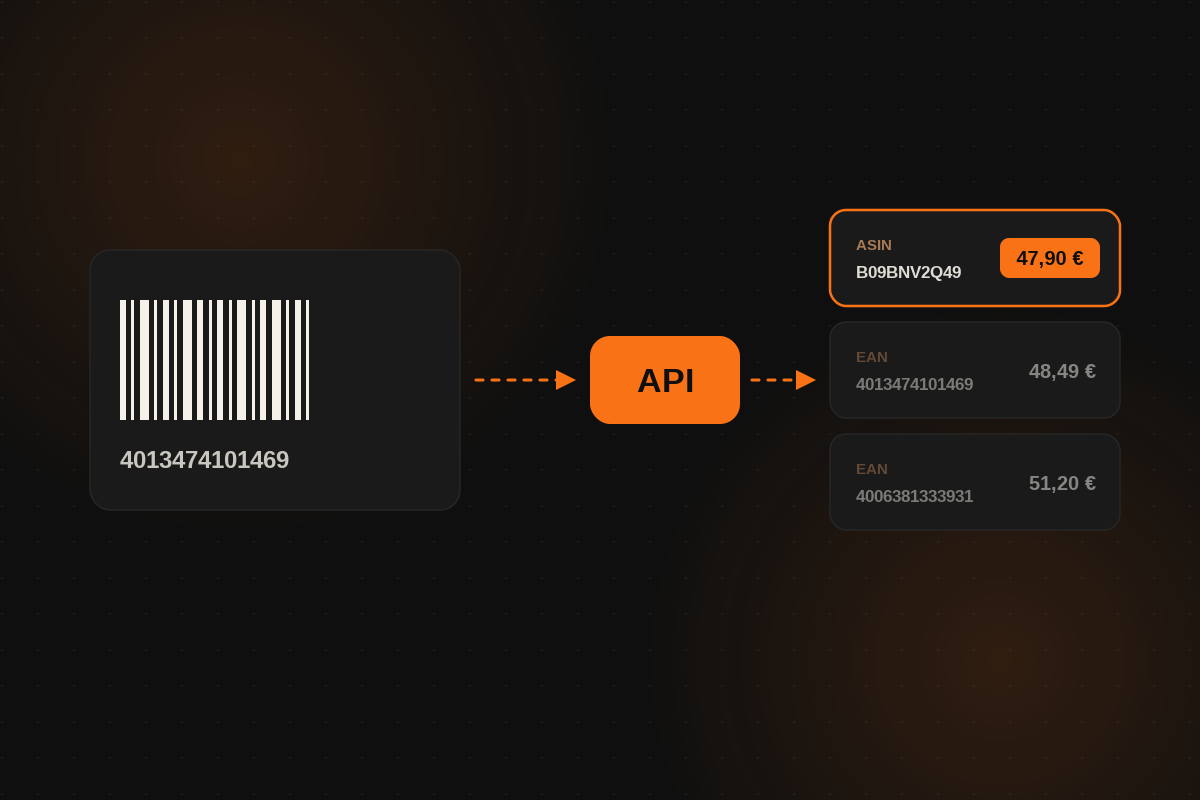
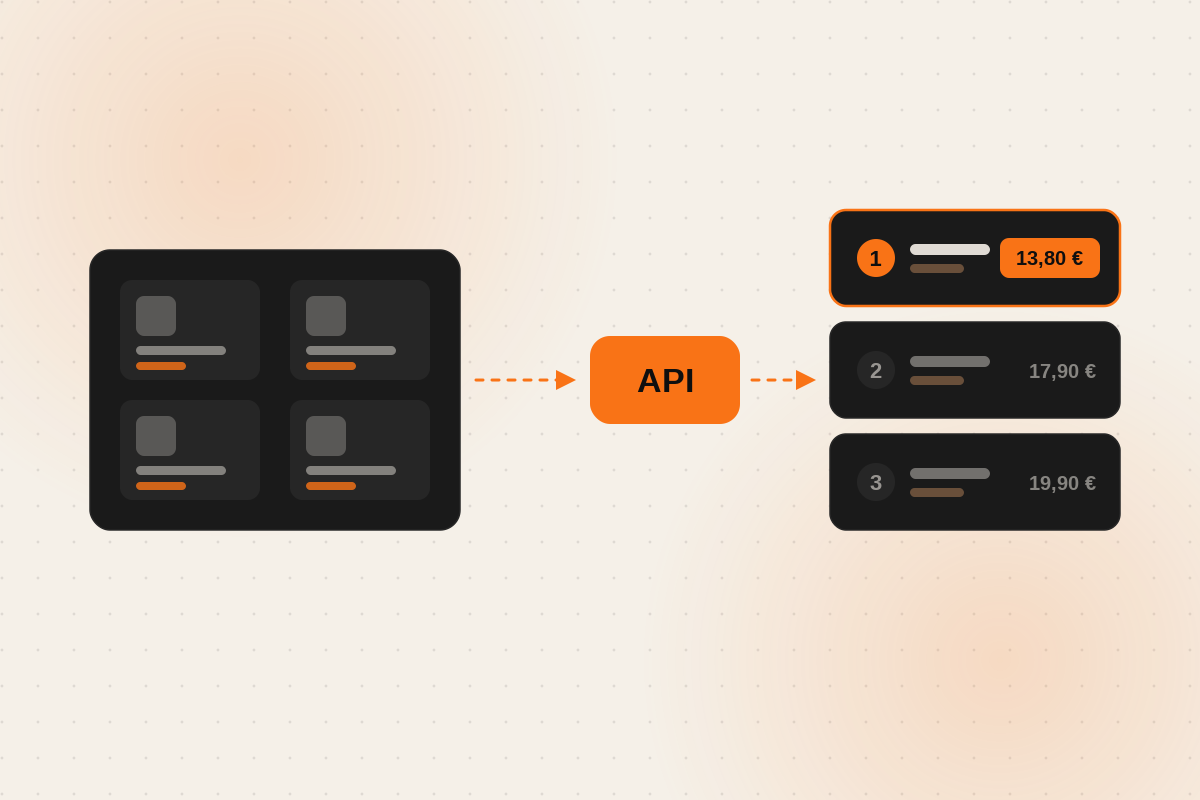
The PricePirate Price API queries Amazon live and returns the offers as JSON or CSV, in the same schema as Idealo, Google Shopping, Klarna, PriceRunner and bol.com. You don’t need an associate or seller account, only an API key.
There are two operations for Amazon:
| Operation | Input | Typical use |
|---|
search-by-gtin | EAN / GTIN / UPC | Look up your own products by barcode |
search-by-id | ASIN | Re-query known Amazon products on a schedule |
23 Amazon marketplaces are supported, including Germany, France, Italy, Spain, the Netherlands, Poland, the UK, the US and Japan. For many of them you can pass a ZIP code so that prices and availability match the delivery location you care about.
One job accepts up to 1,000 EANs at once:
curl --request POST \
  --url https://api-v2.pricepirate.com/api/jobs \
  --header 'Content-Type: application/json' \
  --header 'x-api-key: <api-key>' \
  --data '{"source":"amazon","operation":"search-by-gtin","country":"de","queries":["4013474101469","4006381333931"]}'
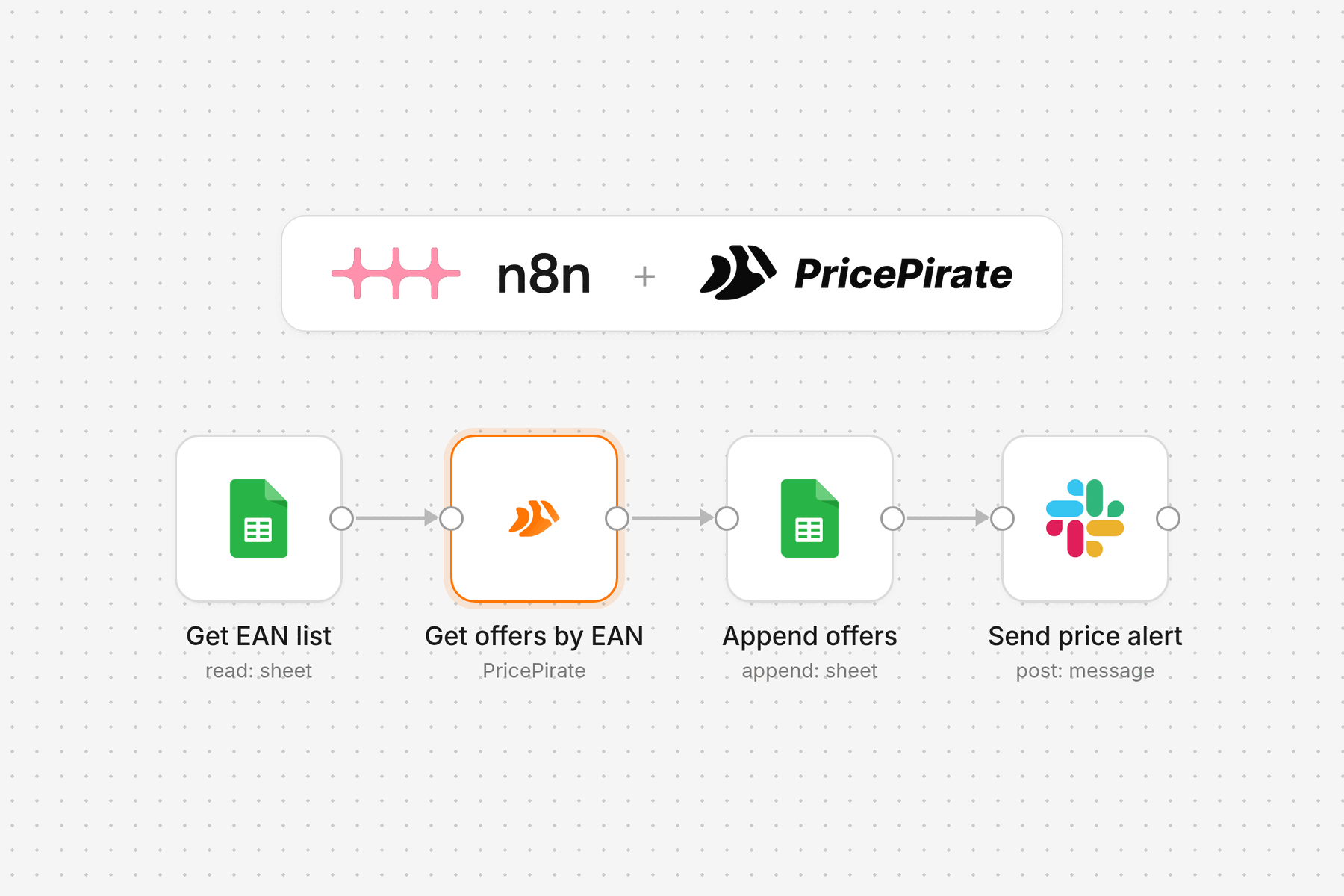
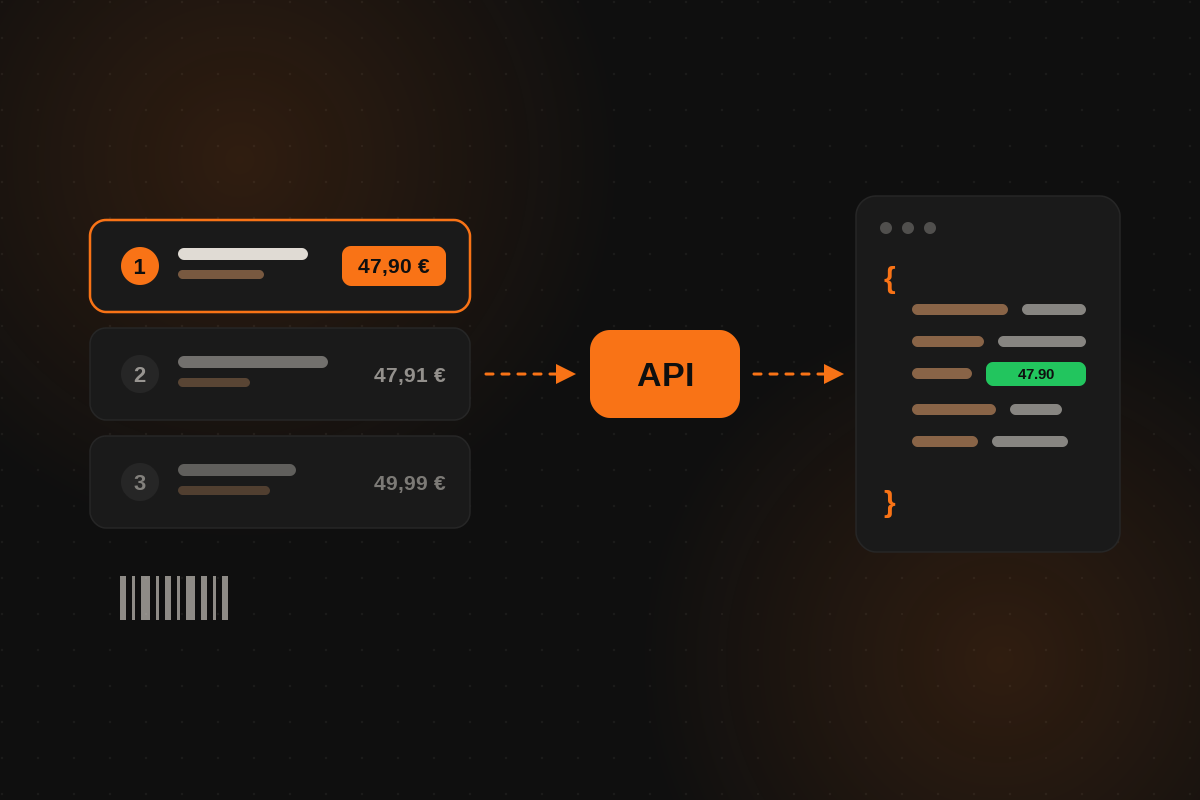
The response contains the job ID. You poll that job until it is completed, then read the offers per EAN with merchant, price, shipping, total and availability. If you would rather work with the data in Excel or a data warehouse, fetch the same job as CSV with one row per offer.
Two things are worth knowing:
- An EAN search uses the first organic ASIN in the search results. For most branded products that is exactly the product you are looking for; for bundles or variants, querying by ASIN is the safer choice.
- The first page of offers is read. A result can be
found and still contain an empty offers array if Amazon is not showing an offer at that moment.
Each query costs one credit, no matter how many offers come back. Pay as you go starts at $55 for 10,000 credits, which is just over half a cent per EAN, and new accounts get 100 free credits. All plans are on the Price API page.
The real advantage of a cross-marketplace price API shows when you query the same EAN on several platforms. You only change source and country:
// Idealo
{ "source": "idealo", "operation": "search-by-gtin", "country": "de", "queries": ["4013474101469"] }
// Google Shopping
{ "source": "google-shopping", "operation": "search-by-gtin", "country": "de", "queries": ["4013474101469"] }
That shows you at a glance whether a product is more expensive on Amazon than on Idealo, which merchants are cheaper on Google Shopping, and where a price change is worth it. How Idealo and Google Shopping differ as channels is covered in Idealo vs. Google Shopping.
Frequently asked questions
Does Amazon PA-API 5 still exist?
No. Amazon has deprecated it and replaced it with the Creators API. Calls to the old endpoint return 403 Forbidden.
Can I use the Creators API for repricing or price monitoring?
The license terms of the Associates program only allow use that sends buyers to Amazon. Aggregating and analyzing the content requires Amazon’s prior written consent. It is therefore not meant for repricing or market monitoring.
Do I need an Amazon account for the PricePirate Price API?
No. You need neither an associate nor a seller account, only a PricePirate API key.
How fresh are the Amazon prices?
Every query hits Amazon live. There is no cached dataset; results are usually ready after one to two minutes.
Can I search by ASIN instead of EAN?
Yes, with the search-by-id operation. For Google Shopping it works with the catalog ID, and for Idealo and bol.com with their own product IDs.
Conclusion
The Creators API is the right route for affiliate sites with ongoing sales. For price comparison, repricing and market analysis it is neither accessible nor permitted. If you need Amazon prices by EAN, ideally next to Idealo and Google Shopping, a price API gets you there faster than your own scraper:
PricePirate is an independent product of UCX Media and has no business, partnership, or other affiliation with Amazon.com, Inc. or its affiliates.